Indian Madhyamaka Buddhist Philosophy After Nagarjuna, Volume 2: Plain English Translations and Summaries of the Essential Works of Chandrakirti, Shantideva, and Two Early Madhyamaka Critiques of God by Richard H. Jones
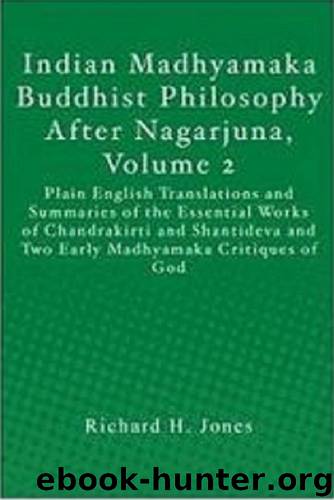
Author:Richard H. Jones [Jones, Richard H.]
Language: eng
Format: epub
Publisher: Jackson Square Books / Createspace
Published: 2014-07-09T00:00:00+00:00
Emptiness Versus Self-Existence in the World
Thus, in this manner lacking discernment into the indisputable doctrine of the twofold truth:
[13] In addition, the error accompanying the objections to emptiness that you make is not ours — it is not applicable to what is empty. Objection : This has a faulty consequence: if the entire world is empty of self-existence, there is no arising or ceasing-to-be, and so forth.
Reply: Such a refutation, cast against us because of a lack of insight into the twofold nature of truth and because of ignorance of the nature of emptiness and its meaning and its purpose, does not apply to our understanding of emptiness. Thus, it is not applicable. In alleging a refutation of emptiness, you charge, slander, attack, and reject emptiness, but your accusation does not apply to us. Your accusation is made by superimposing “nonexistence” onto the idea of “emptiness.” But we do not maintain that the meaning of “nonexistence” is that of “emptiness.” What is it then? It is “dependentarising.” Thus, it is not acceptable to attack the very doctrine of “emptiness.”
[500] Not only are these stated refutations not applicable to our position, but in addition the entire system of Buddhist doctrines becomes more intelligible (by accepting emptiness as it is properly understood). Thus, Nagarjuna explains:
[14] For whom emptiness is admissible, everything is admissible. For whom emptiness is inadmissible, everything is inadmissible. All that is described here is admissible for the one to whom the emptiness of self-existence in all entities is admissible. For such a one everything in the way we have explained is admissible. Why? Because we explain “dependentarising” as “emptiness of self-existence.” As stated in one text: “What arises from conditions is not arisen (since it is not real), and there is no arising from self-existence (since the real is eternal). Whatever depends on conditions is said to be empty of self-existence. Whoever comprehends emptiness is free of delusion.” Also from the Perfection of Wisdom texts: “All basic phenomena of the experienced world are empty because they lack self-existence.”
Thus, dependent-arising is admissible to one for whom emptiness is admissible, agreeable, and acceptable. In addition, the four noble truths are admissible to one for whom dependent-arising is admissible. Why? Because it is precisely what arises dependently that is suffering, not what does not arise dependently. What arises dependently also is empty because it is not self-existent. When there is suffering, then the arising of suffering, the cessation of suffering, and the way to cessation of suffering are possible. Thus, a clear grasp of suffering, the elimination of its arising, the realization of its cessation, and the practice of the way are all possible.
[501] If there are the truths of suffering and thegrasping of them and so forth, then their spiritual fruit is possible. When the fruits are possible, recipients of the fruits are possible. When recipients are possible, aspirants are possible. When aspirants are possible, the community of monks and nuns is possible. When there are Buddhist truths, then there is the Buddhist doctrine.
Download
This site does not store any files on its server. We only index and link to content provided by other sites. Please contact the content providers to delete copyright contents if any and email us, we'll remove relevant links or contents immediately.
| Anthropology | Archaeology |
| Philosophy | Politics & Government |
| Social Sciences | Sociology |
| Women's Studies |
The remains of the day by Kazuo Ishiguro(8977)
Tools of Titans by Timothy Ferriss(8366)
Giovanni's Room by James Baldwin(7330)
The Black Swan by Nassim Nicholas Taleb(7109)
Inner Engineering: A Yogi's Guide to Joy by Sadhguru(6785)
The Way of Zen by Alan W. Watts(6601)
Asking the Right Questions: A Guide to Critical Thinking by M. Neil Browne & Stuart M. Keeley(5759)
The Power of Now: A Guide to Spiritual Enlightenment by Eckhart Tolle(5754)
The Six Wives Of Henry VIII (WOMEN IN HISTORY) by Fraser Antonia(5498)
Astrophysics for People in a Hurry by Neil DeGrasse Tyson(5182)
Housekeeping by Marilynne Robinson(4436)
12 Rules for Life by Jordan B. Peterson(4299)
Double Down (Diary of a Wimpy Kid Book 11) by Jeff Kinney(4261)
Ikigai by Héctor García & Francesc Miralles(4247)
The Ethical Slut by Janet W. Hardy(4242)
Skin in the Game by Nassim Nicholas Taleb(4239)
The Art of Happiness by The Dalai Lama(4125)
Skin in the Game: Hidden Asymmetries in Daily Life by Nassim Nicholas Taleb(3991)
Walking by Henry David Thoreau(3953)
